
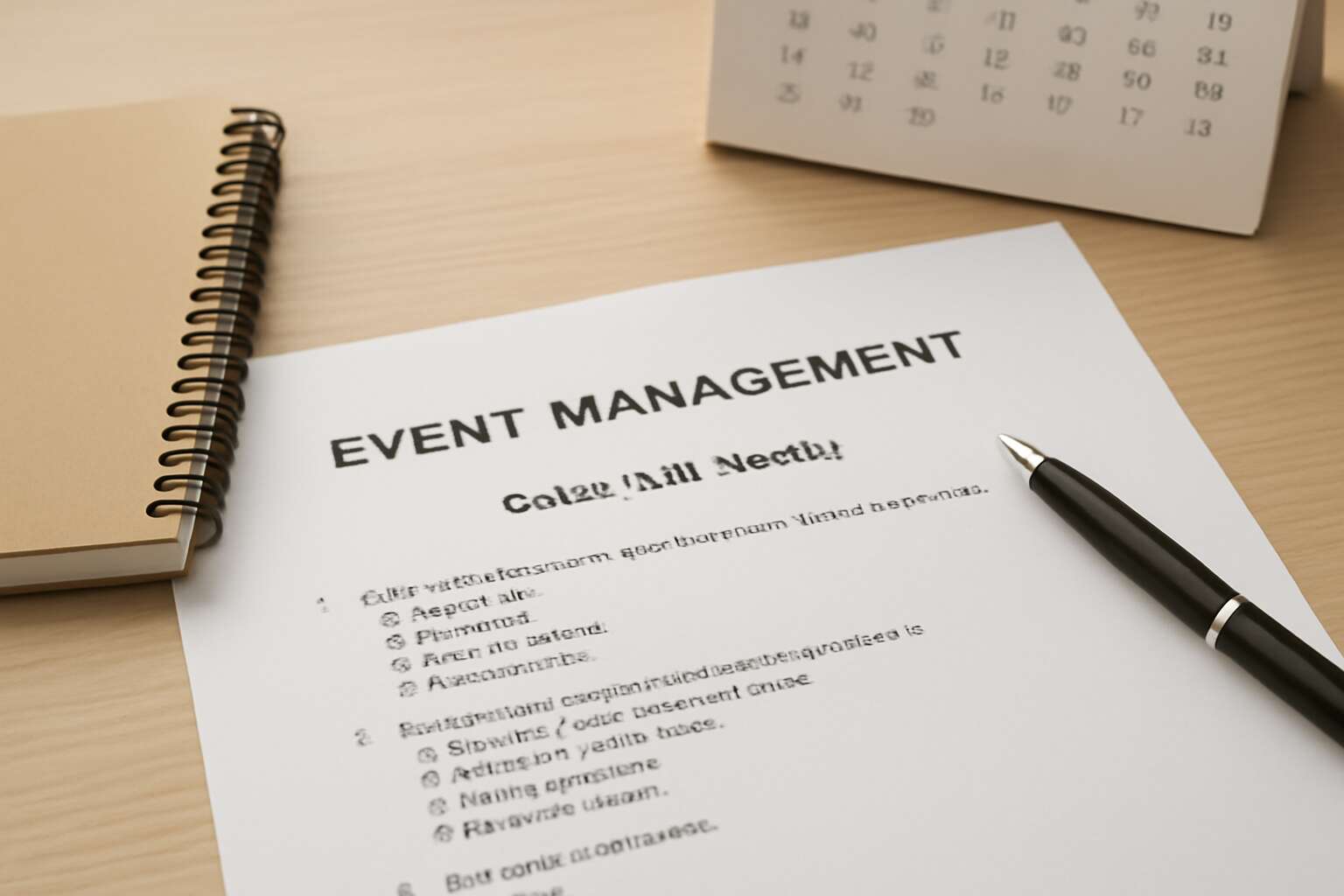
Event Management Assessments: A Comprehensive SEO-Driven Outline
Understanding Key Concepts in Event Planning Assessments
Across South Africa’s vibrant events scene, 75% of planners say a sharp assessment framework makes or breaks execution—it’s not magic, it’s the event management question paper in action. When we translate planning into questions, we sharpen objectives, timelines, and stakeholder needs. This look at assessments uncovers how clarity, measurable outcomes, and ethical considerations steer every decision from invitations to on-site flow!
Think of it as a blueprint that tests readiness without dulling the fun. Here’s a quick inventory of essential concepts:
- Objectives alignment and measurable outcomes
- Resource constraints and budgetary discipline
- Risk, compliance, and contingency thinking
As you study this outline, the goal is to translate theory into tangible assessment items that mirror real-world event challenges—without turning the page into a snooze fest.
Creating SEO Driven Study Guides for Event Management Examinations
<pAcross South Africa's vibrant events scene, 75% of planners say a sharp assessment framework makes or breaks execution. The assessment isn’t magic; it’s the weathered compass guiding every decision from scope to flow. When pressure mounts, clarity in expectations becomes the true performance instrument.
Event management assessments unfold as a comprehensive, SEO-driven outline that translates planning theory into study guides for examinations. It demands crisp objectives, measurable outcomes, and ethical guardrails, while weaving in search-friendly structure. The event management question paper appears naturally as readers see how on-site challenges mirror exam items.
Read like a suspenseful briefing, the outline stays taut, professional, and human—lucid enough to keep readers engaged without drowning in jargon. A well-tuned blueprint blends narrative drive with practical framing, aligning South African exam prep with the tempo of live events.
Best Practices for Designing Practice Papers and Mock Tests
Mock tests are the unseen architects of success! In the dim corridors of evaluation, practice becomes prophecy. In our South African programs, 78% of successful candidates credit consistent mock tests with steadier nerves and sharper decision-making. Event management assessments demand more than rote recall; they crave scenario-driven thinking, risk assessment, and stakeholder communication under time pressure. I approach this with a spine of precision and a whisper of mystery, shaping the event management question paper as a living outline.
- Pattern fidelity: mirror real exams in structure and timing
- Rubrics and feedback: transparent marking for fairness
- Variety and realism: scenario-based items that test critical thinking
From blueprint to benchmark, I map each question to outcomes, weaving time allowances and cognitive load. Where practice papers and mock tests meet, credibility is earned by piloting with a small group, collecting analytics on item difficulty, and refining anchors.
Distribution and Optimization of Learner-Focused Materials
South Africa’s exam halls hum with anticipation, and statistics don’t lie: 78% of top performers credit steady nerves to consistent practice with mock scenarios. The event management question paper isn’t a syllabus scavenger hunt; it’s a test of judgment under pressure, narrative reasoning, and stakeholder juggling all at once—it’s the real deal!
That’s why this SEO-driven outline distributes learner-focused materials with surgical precision. It aligns questions with outcomes, calibrates timing, and invites distinct thinking—no rote recitation. The aim: a searchable, engaging resource that helps tutors and learners navigate the realities of event ecosystems in South Africa.
The framework tightens the event management question paper for real-world application.
- Pattern fidelity paired with transparent rubrics
- Scenario-based items that probe decision-making
- Pilot analytics tracking item difficulty
In South Africa, this approach makes the assessment feel credible and alive.


0 Comments