
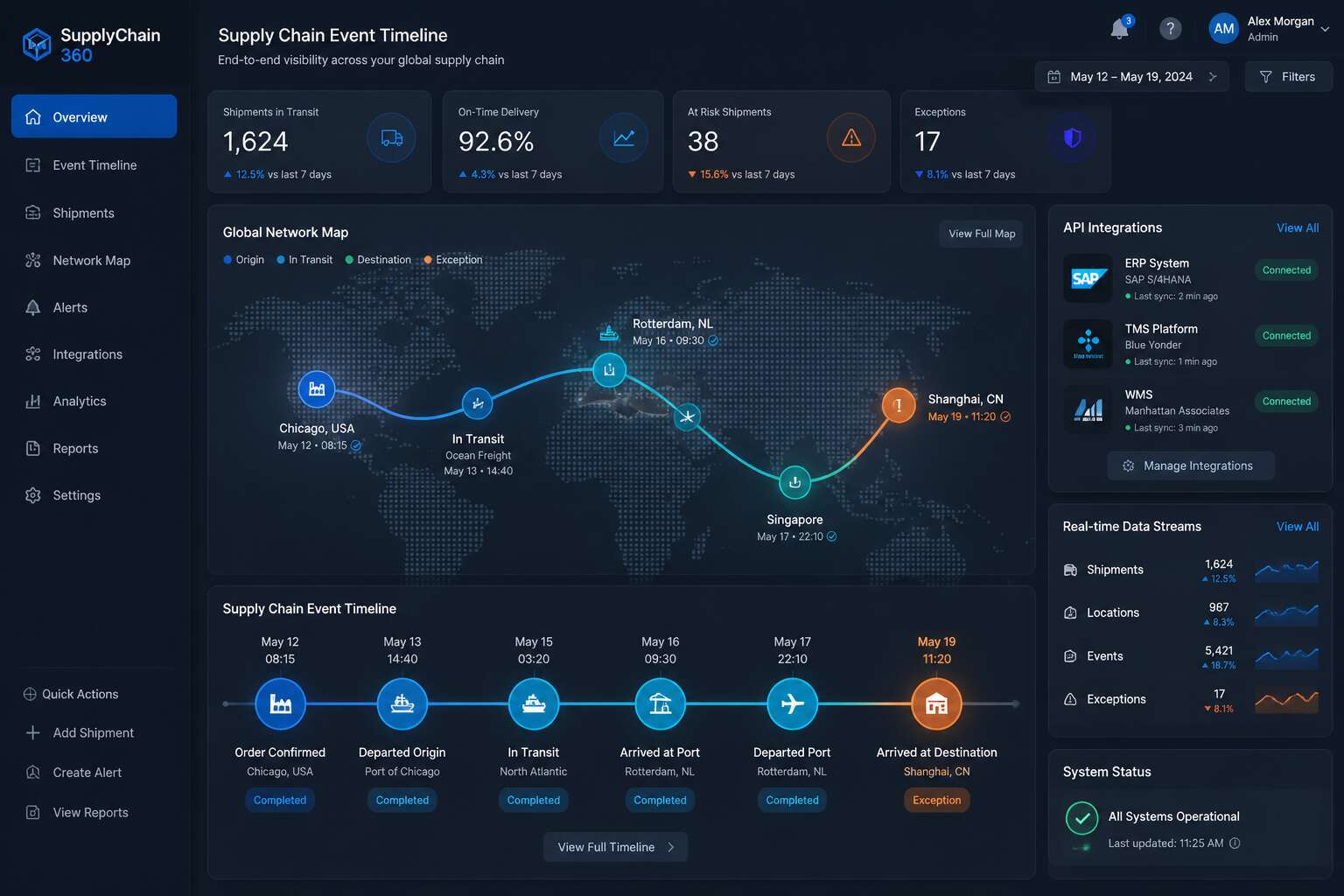
Foundations of Procurement Event Tracking
Why Real-Time Visibility Matters in Supply Chains
The cargo does not announce its delay. It simply does not arrive, and the silence spreads through warehouses and order books. For South African procurement teams, this is the cost of blind trust in hand-typed spreadsheets. The sap ariba event management api translates supplier confirmations, shipping milestones and invoice exceptions into a single, legible stream. When a vessel idles off Durban or a rail link stalls, it marks the rupture before the rupture becomes a crisis. Real time visibility converts uncertainty into a sequence of known events.
A foundation for tracking rests on three pillars:
– A shared ledger of events, visible to every stakeholder
– Automated alerts when a promise breaks
– A traceable path from order to delivery
Teams that see the break early retain their standing in the market.
The Evolution of SAP Ariba Integration Capabilities
Foundations of procurement event tracking were built on paper trails and fax confirmations. Each milestone lived in its own silo. The evolution of SAP Ariba integration capabilities changed that by connecting systems rather than people. We now see a single event stream, not a patchwork of forwarded emails.
The sap ariba event management api allows teams to map milestones, attach documents and trigger responses without custom code. Integration has moved from static file drops to live data flows.
- Purchase order creation feeds the tracking ledger
- Shipment updates arrive directly from logistics providers
- Invoice exceptions create alerts for the procurement team
This shift matters for South African operations where multiple transport modes meet. The api collapses the distance between event and action.
Key Terminology Every Developer Should Know
To code against the sap ariba event management api, use a precise vocabulary. An event is a discrete state change. A shipment is one. A milestone marks the point where that change enters the tracked flow. An acknowledgment confirms receipt without collision.
- Subscription: the expressed filter for which event types your system needs.
- Callback: the endpoint that consumes each incoming event.
- Payload: the immutable structure that arrives with the callback.
South African supply chains run on rail, road, and ocean. Each mode produces a unique event stream. A failure to link a callback to a subscription payload creates a silent gap in the data. I define these terms before my first endpoint, and the api behaves predictably.
Essential Capabilities of the SAP Ariba Platform for Event-Driven Integration
Event Subscription and Filtering Models
Cape Town procurement teams often discover that their systems speak past one another, a phenomenon that costs the economy billions in missed opportunities each year. The sap ariba event management api exists precisely to remedy this dissonance. It enables a business to define which operational occurrences warrant attention, from a supplier price adjustment to a delivery date shift. This configuration gives the platform a kind of situational awareness that static integration simply cannot offer.
The subscription model here is remarkably specific. You can direct the api to listen for a particular change in a purchase order line, then broadcast that event to a specific system in your network. It is a little like instructing a competent assistant to ignore the general office chatter and only alert you when a specific client walks through the door. This precision prevents the noise of daily business from obscuring the signals that truly demand a response.
What makes the filtering mechanism particularly elegant is its ability to capture the nuance of a commercial relationship. A supplier in Sandton might have a standing arrangement where a five percent cost variation is acceptable, while a key component provider in Durban requires immediate notification for any alteration. The sap ariba event management api permits this granularity without demanding cumbersome custom code on your side. It handles the heavy lifting of interpretation, which means your team can focus on the actual response rather than building the infrastructure to hear the news.
The platform accomplishes this through a publish and subscribe architecture that feels quite refined in practice. Your internal systems indicate their interests ahead of time, and the api does the rest. This arrangement converges with the reality of local business, where Eskom load shedding and Transnet port delays can create sudden, cascading changes in the supply chain. An event captured at the source becomes a valuable piece of information that allows a buyer in Johannesburg to react before a delay becomes a crisis. The api converts raw operational data into something far more useful: a prompt, actionable notification.
Webhooks and Callbacks: How They Work
A single missed callback can halt an entire production line. Webhooks operate as a direct line of communication. When a supplier confirms a delivery, the sap ariba event management api sends a payload to your registered endpoint. No polling, no waiting. The callback confirms receipt, and the handshake is complete.
This delivery model relies on several capabilities:
- Retry logic for failed transmissions.
- Payload verification through signed headers.
- Endpoint health monitoring.
These features matter in a country where network interruptions are routine. A webhook that silently drops a message creates the same problem as a late truck. The platform’s callback mechanism ensures you know when a message arrives and when it does not. That certainty transforms integration from a gamble into a dependable process.
Understanding Event Payload Structures
Understanding the payload structure is essential when working with the SAP Ariba Event Management API. Each event carries a JSON body with header data, order references, and status codes. You need to know which fields are mandatory and which are optional to avoid parsing errors. The API also supports custom extensions, so you can map internal identifiers. For example, a shipment update includes location, timestamp, and carrier details. Without this clarity, your integration fails without a trace. Look for these essential capabilities:
– Schema validation to reject malformed events.
– Versioning to handle payload changes.
– Error codes that pinpoint failures.
Master the payload, and your supply chain notifications become reliable. That is the core of successful event driven integration.
Rate Limit Management for High-Volume Data
When high-volume data flows through the SAP Ariba event management API, rate limits can become a silent bottleneck. The platform enforces these limits to protect shared resources, but that doesn’t mean your integration has to suffer. Essential capabilities include dynamic throttling, which adjusts to your current usage pattern, and priority queues for critical events like purchase order confirmations. A well-designed retry mechanism with exponential backoff also prevents outbursts during peak cycles. The real value lies in the API’s usage headers, giving you real time visibility into remaining quota. Without these features, a sudden spike in shipment updates could lock you out entirely. For South African enterprises managing global trade lanes, that is not an option. The SAP Ariba event management API turns this constraint into a predictable, manageable rhythm, so your operations keep moving while others wait.
Exploring Sandbox Testing Environments
A sandbox is where the sap ariba event management api becomes tangible. It transforms abstract endpoints into something you can break, fix, and refine. The test environment mirrors production behavior, including event payloads and subscription validation. You can verify that a goods receipt triggers the correct downstream response without polluting live data. That matters for South African logistics teams who cannot afford guesswork at the border.
Essential capabilities for effective event driven integration live behind simple interface elements:
- A granular event catalog that exposes schema changes before they reach production
- Reusable test scenarios that simulate supplier failures, duplicate events, and late acknowledgements
- Detailed trace logs that isolate the exact moment a subscription misfires
Push the sandbox to its limits. Flood it with malformed requests. The tooling gives you certainty before a single production event flows through the sap ariba event management api.
Building a Resilient Integration Layer for Procurement Events
Authentication Flows: OAuth2 and Beyond
Resilience is the quiet backbone of any procurement integration, and that truth becomes loudest when your SAP Ariba event management API call fails mid-authentication. OAuth2 flows feel straightforward until token refresh windows collide with network latency or a downstream service hiccup. You need more than a valid client ID and secret; you need a strategy that anticipates 401s, handles clock skew, and retries without duplicating purchase orders.
A layered approach matters. First, store tokens securely and refresh them proactively, not reactively. Second, design your callback endpoints to tolerate duplicate event deliveries, because Ariba may resend webhooks under load. Third, monitor token expiry metrics across environments.
– Implement short timeouts with exponential backoff.
– Validate the `expires_in` value against your own server clock.
– Log every auth failure with correlation IDs.
Beyond OAuth2, consider mTLS or signed JWTs for machine-to-machine calls, especially when compliance demands non-repudiation. The SAP Ariba event management API rewards teams that treat authentication as a living system, not a static handshake. Build for retries, expect anomalies, and your integration will hold firm when the network decides to misbehave.
Retry Strategies for Network Failures
Network instability is a constant reality in South African supply chains. A dropped callback from the sap ariba event management api can break a procurement workflow, leaving buyers blind to shipment delays. The fix is a deliberate retry architecture.
Our integration layer treats every failed request as a transient state, not a terminal error. We apply exponential backoff with jitter to avoid server load spikes. We store the raw event payload locally before acknowledging receipt. This guarantees replay without losing original data.
- Store the raw payload to a durable queue before processing.
- Apply exponential backoff with random jitter to space out retries.
- Implement idempotency keys to prevent duplicate purchase orders on replay.
This layered resilience keeps procurement operations moving when the carrier network stumbles. By designing for failure, you turn the sap ariba event management api into a dependable source of truth, regardless of local connectivity.
Transforming Raw Events into Business Actions
A procurement event is a statement of fact. The sap ariba event management api transmits that fact. Whether it becomes an action depends on the integration layer you build between the API and your workflows.
That layer does more than transport data. It interprets. Raw payloads arrive with timestamps, statuses, and identifiers. I have seen teams treat these fields as self-evident, only to discover a missing mapping fails a batch of purchase orders. Your layer must carry each message through validation, enrichment, and semantic mapping. Procurement outcomes are decided here.
- Schema validation, rejecting malformed payloads immediately.
- Vendor enrichment, merging contract terms with current status.
- Workflow routing, applying rules that separate routine events from exceptions.
- Durable persistence, ensuring the event exists before any action depends on it.
The sap ariba event management api delivers the event. Your integration layer supplies the interpretation. Procurement runs on the latter!
Security Compliance in Cross-System Data Exchange
Resilience is not a feature you bolt on. It is the quiet architecture that keeps procurement alive when systems disagree. The sap ariba event management api delivers events, but those events must survive transit, transformation, and the occasional hostile network. I have watched a single certificate expiry stall an entire supplier onboarding queue. That is the cost of ignoring security compliance in cross-system data exchange.
A resilient layer anticipates failure before it becomes drama.
Encryption at rest and in transit, without exception.
Credential rotation on a schedule, not on a whim.
Audit logs that record every decision, even the boring ones.
Regional data residency checks, because South African regulations do not care about your convenience.
The API does not enforce your compliance posture. That burden belongs to the layer you build. Build it with paranoia, and procurement will thank you.
Advanced Optimization Techniques for Event-Driven Procurement Systems
Implementing Idempotent Consumers to Ensure Data Consistency
Duplicate events are not anomalies; they are a certainty. A serious SAP Ariba event management API implementation must treat every webhook delivery as potentially repeated. This is where idempotent consumers become essential.
Idempotency means processing the same event twice produces the same result as processing it once. The SAP Ariba event management API does not guarantee exactly-once delivery. It guarantees at-least-once. That distinction dictates your entire architecture. A supplier update, a purchase order change, or a contract amendment processed twice could corrupt downstream systems.
Consider what your consumer stores:
- A processed-event identifier in a dedicated table with a unique constraint.
- A transaction ID from the event payload used as the natural key.
- A status field that only moves forward in the workflow state.
South African procurement teams relying on these APIs need deterministic outcomes. I have seen fragile integrations fail here; the difference between a reliable system and a broken one often comes down to how gracefully it handles a duplicate payload.
Monitoring Latency and Throughput in Real Time
Monitoring latency and throughput in real time turns the SAP Ariba event management API from a black box into a measurable system. South African procurement teams often discover performance issues only after users complain.
A practical approach involves tracking the time between event emission and consumer acknowledgement. This reveals network bottlenecks and processing delays. Throughput metrics show how many events your pipeline handles per minute, helping you predict capacity constraints before they become failures. The SAP Ariba event management API provides timing headers that support this analysis, but you must capture them at the moment of receipt.
Useful metrics to observe:
– Median and percentile latency for event delivery
– Consumer processing time per payload
– Queue depth and backlog growth
– Failed delivery counts per endpoint
These indicators separate healthy systems from fragile ones. When latency spikes, you can trace the cause to a specific integration or congested network path. When throughput drops, you know whether to scale consumers or adjust subscriptions.
Versioning Event Schemas to Avoid Breaking Changes
Versioning event schemas is the quiet discipline that keeps South African procurement systems stable while partners move at different speeds. The sap ariba event management api does not lock event formats forever. Producers and consumers must agree on field names, types, and semantics. A single change in payload structure can cause downstream failures in invoice processing.
Most event contracts include a version field in the payload. Backward compatible additions handle new optional fields, while major version bumps signal genuine structural changes. Renaming an existing field is the fastest way to break every consumer relying on that API contract.
Trading partners often follow a shared deprecation schedule, allowing six months of parallel testing. That longer window keeps older systems active while newer ones integrate, which matters for South African teams with mixed network reliability.
Handling Duplicate Events with Deduplication Logic
Duplicate events in procurement networks are more common than most teams admit. A supplier resends a dispatch notice, a network retry times out, or a webhook fires twice. Each duplicate triggers a separate approval workflow, a double payment, or a delayed order line. The sap ariba event management api provides the raw event stream, but deduplication logic lives in your consumer layer.
Effective deduplication starts with a stable fingerprint. Hash the core business fields, not the entire payload, because timestamps and metadata change on retries. Store the fingerprint with a time window that matches your transaction lifecycle.
- Transaction ID plus line number for purchase orders
- Supplier ID plus shipment reference for dispatches
- Invoice number plus submitter for financial events
Window the lookup against your event store, not the source system. The sap ariba event management api delivers events in near real time, but source systems may not reflect the accepted duplicate for several seconds. Build your deduplication cache to outlive the longest expected retry interval.
Debugging Errors Using Correlation IDs
Correlation IDs transform debugging in SAP Ariba Event Management API from guesswork into precision. Each event carries a unique ID that threads through every retry and callback. When errors occur, inspect that ID in logs to isolate the faulty step. For optimization, consolidate related events into batched payloads and filter unnecessary fields before transmission. This reduces network overhead and speeds processing.
Always validate the ID format early; malformed IDs break traceability across systems. Use a centralized log aggregator to correlate IDs with timestamps and response codes. With these practices, you resolve failures faster and keep procurement workflows resilient.
Scaling Event Processing with Message Queues
Consider that a major retailer using SAP Ariba Event Management API might process tens of thousands of purchase order updates during a peak sales period. The API endpoint itself becomes the bottleneck. Placing a message queue between the API and your downstream systems changes the game entirely. The queue acts as a shock absorber, allowing the API to acknowledge events quickly while your processors work through the backlog at a sustainable pace.
This decoupling is the secret to scaling event-driven procurement systems. Your integration now handles burst traffic without dropping a single notification. You gain the ability to replay events, monitor queue depth, and scale processors independently of the API call volume. The critical metric shifts from request latency to processing throughput. A healthy queue means a resilient system.
The elegance lies in the separation. The SAP Ariba Event Management API governs the event flow, while the message queue governs the data flow. You can prioritize high value events, such as shipment confirmations, over routine status updates. This prevents a flood of minor events from starving critical operations of compute resources. Your architecture finally reflects the actual business priorities.
Real-World Implementation Roadmap and Best Practices
Step-by-Step Guide to Going Live
Rolling out the SAP Ariba Event Management API requires a phased approach. Start with a pilot that mirrors your production environment but limits the event volume. This lets you validate authentication and payload mapping without overwhelming your team.
From there, build a go-live checklist that prioritizes operational readiness. Define clear escalation paths for failed events and assign owners for each alert type. Test your retry logic under simulated network failures, and confirm that your monitoring dashboard captures the right metrics.
A practical sequence looks like this:
1. Confirm sandbox parity with production data.
2. Run load tests against rate limits.
3. Validate idempotency keys on duplicate events.
4. Review security logs before enabling live traffic.
These steps keep the SAP Ariba Event Management API integration stable from day one.
Common Integration Pitfalls and How to Avoid Them
Rolling out the SAP Ariba Event Management API in a live South African environment often demands more than technical readiness. The roadmap should include a feedback loop with business stakeholders who interpret event data for procurement decisions. Their input shapes which events deserve priority handling and which can be queued during peak cycles. This collaborative layer prevents the integration from becoming an isolated technical artifact.
Common pitfalls surface when teams assume event delivery guarantees absolute data freshness. The SAP Ariba Event Management API delivers in near real time, but network latency and middleware hops introduce acceptable delay. Another frequent error involves ignoring payload size variability. A small purchase order event may weigh a few kilobytes, while a complex contract event can span much larger structures. Build parsers that accommodate this range.
– Insufficient logging on consumer endpoints causes blind spots during incident diagnosis.
– Overlooking timezone differences between Ariba’s servers and local systems skews timestamp interpretations.
– Treating every event as equally critical dilutes monitoring efforts and delays genuine alerts.
Avoid these traps by designing for operational imperfection from the start. Successful teams document every deviation and refine their handling logic continuously. The goal is not perfection, but predictable behavior under real-world conditions.
Measuring ROI: KPIs for Automated Event Management
Implementation roadmaps in South Africa often underestimate the distance between technical delivery and business value. When the sap ariba event management api goes live, the real work begins with measuring what changed. I define ROI through KPIs that connect event flow to procurement decisions.
Track these indicators for automated event management:
- Event delivery latency across the full network path
- Share of events that alter a purchase order or contract
- Time spent reconciling missing or malformed events
These measurements expose friction. A fast api that delivers events nobody acts on delivers no return. Pair volume metrics with outcome metrics. That pairing shows where the roadmap needs adjustment while revealing where the system runs clean.
Future Trends in Procurement Automation and APIs
South African enterprises often discover that the roadmap to automated procurement is rarely direct. The sap ariba event management api performs predictably inside a sandbox, but production reveals the truth. Load shedding, fluctuating network stability, and legacy ERP systems shape the real implementation roadmap. Build staged rollouts that let the api push events into a shadow queue before switching live traffic. That buffer exposes failures without halting procurement.
Future trends point toward tighter coupling between event streams and predictive procurement. Machine learning models will consume the sap ariba event management api feed directly, adjusting stock levels before a buyer submits a request. Best practices for procurement automation and APIs are also shifting:
- Event schemas are getting stricter across the sector.
- Every event must map to a legal procurement action.
- Failed deliveries now require a named owner.
Teams treating events as a primary asset outperform those viewing them as a side effect.



0 Comments